

Convocation 2026
When Stephanie Krauss asked an auditorium full of UT Public School educators at convocation to describe how they were feeling on the Menti app for interactive presentations, one word rose to the top and stayed there: tired. It was not a surprise. For six years, across every community she has visited, the answers have been the same. They have included descriptions like overwhelmed, busy, stressed, stretched to the max. “This is not a personal failure,” Krauss told the crowd. “This is not just you.”
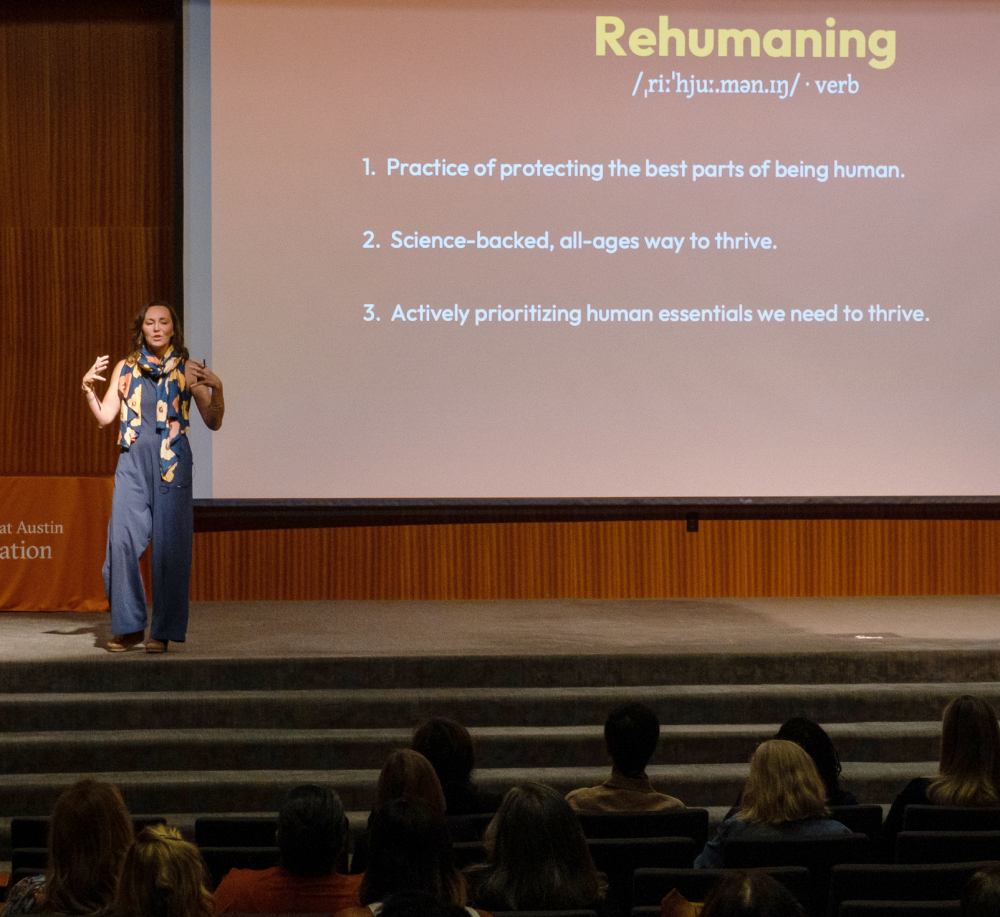
Krauss, a former teacher, social worker, and author of How We Thrive, argues that adults and children alike are living through a kind of relentless storm that she describes as being “overtapped, overworked, overstimulated, and overwrought.” The result isn’t burnout, she says, but something deeper: depletion. The frantic pace of modern life pulls us away from the very things we are built to need.
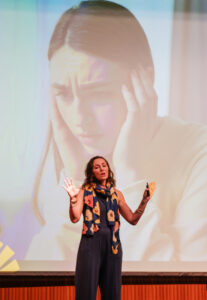
Her central claim is bracing in its simplicity. Humans have existed for 300,000 years. The Industrial Revolution was 300 years ago, and it represents only one percent of our history. Strauss says the frenetic recent past is “one percent of one percent.” What we now call normal, she insists, is not natural. And because scientists expect today’s children to live to 100, the stakes are enormous: no one should feel this exhausted for this long.
The good news, Krauss says, is that the antidote is already within us. Drawing on interviews with more than 100 scientists and scholars (including one of UT Public Schools’ superintendents, Dr. Nicole Whetstone, and Director of Academics and Curriculum, Dr. Veronica Ruiz Winner) Krauss laid out a framework of human “essentials” spanning body, mind, heart, and spirit. The body needs to eat, sleep, move, and regulate. She urged schools to favor fresh foods instead of overprocessed food, to honor adolescent sleep science, and to protect movement, especially recess for our kids. Regulation, she reminded the audience, is binary and bodily: the brain constantly asks whether it is safe, and behavior we read as defiance is often dysregulation in disguise.
Krauss observed that UT Charter School really understands how to children regulate and noted that Ruiz Winner teaches staff regulation as first aid.
Krauss told the faculty and staff from UT Public Schools that the mind, too, has primal capacities: play, wonder, flow, and creativity. Play, Krauss emphasized, “is as much about preparation as it is about pleasure.” For most of human history, children learned by playing, and yet schools often treat it as a privilege to be earned. Wonder opens us to awe, which research shows is among the most protective factors against trauma. Flow, our capacity for deep focus, is shattered by what she calls “interruption, interaction, distraction.” She reminds us that after focus is shattered, it takes an average of 23 minutes to refocus.
 Krauss told the audience that connection, love, and belonging matter most. Loneliness, she noted, causes measurable physical pain, a biological alarm urging us back to our people. In an age of AI companions, Krauss offered this rule: “bodies before bots.” Belonging, she added, is one of the most effective educational interventions there is, built through “a million gestures, smiles, and handshakes.”
Finally come the essentials of the spirit: celebration, contribution, and belief. Teenagers, often assumed to be disengaged, need to contribute more than anyone. And belief or faith in something bigger and better fuels hope, which she distinguished from mere optimism: “Hope has goals. Hope has a why.”
Krauss closed by reading from the foreword of her book, written by her son, 12-year-old Harrison. He wrote about kids being stressed and overwhelmed. “I don’t want to just live my life. I want to enjoy it,” he said. Krauss’ appeal to educators was personal and urgent. Rehumaning, she said, requires no purchases and no training—only awareness, action, and advocacy. “Normal is not natural,” she reminded them, “but it’s also not permanent.”